Most team building is built for a dozen people and then stretched to fit two hundred. Here is what actually keeps a large group together.
I have spent my career running team building for large groups, hundreds of people at once and sometimes a few thousand. What I learned early is that most team building breaks the moment the group gets big.
The way you actually keep a large group connected is to break everyone into teams of four to six, give them one shared game they all play at the same time, and let those teams compete in real time so they can see how they are doing against each other. On top of that you write in collaborative clues that force teams to find and work with other teams, and you build the whole thing for introverts and extroverts and every mobility in the room. Built that way, large group team building scales from a few dozen people to a few thousand.
That is the short version. The long version is everything I have picked up running these for groups as large as three thousand, so let me walk you through it.
Why Team Building for Large Groups Usually Falls Apart
Most team building is designed for a dozen people and then stretched to fit two hundred. Almost any group activity gets hard to manage once you are past thirty people, and there are not many private spaces that can even hold a group that big, so you end up splitting everyone into smaller pods that never actually meet.
And once you split a big group up, those pods just stay in their own corners. Take an escape room, or Topgolf, or axe throwing: you can run enough rooms or enough bays for everyone, and on paper the whole company is playing together, but each little team is really playing on its own. They are not competing against the other teams, and they are not interacting with them either. You come in as two hundred people, and you leave as two hundred people who stood a little closer together for an afternoon.
That is the real problem with team building activities for large groups. People have fun. They just do not leave knowing anyone they did not already know.
Why Large Group Team Building Starts With Teams of Four to Six
The fix starts with a number: four to six people per team. That is the range we have landed on, and we have been building around it for a long time.
Here is why it works. Four to six people is enough brainpower to actually solve something together, and still small enough that nobody can coast. Go smaller and the team cannot get everything done, and go bigger and you start getting people on the sidelines, checked out and waiting for it to be over. At four to six, everyone has to contribute, and that is the whole point.
Put a big group into the wrong size teams and people either feel isolated or drift back to the coworkers they already know, never talking to anyone new. Four to six is what stops that.
What Scavenger Hunt Team Building Does That Topgolf Cannot
Once everyone is in the right size team, you need one game that all of them play at the same time, and this is where a scavenger hunt does something most team building simply cannot.
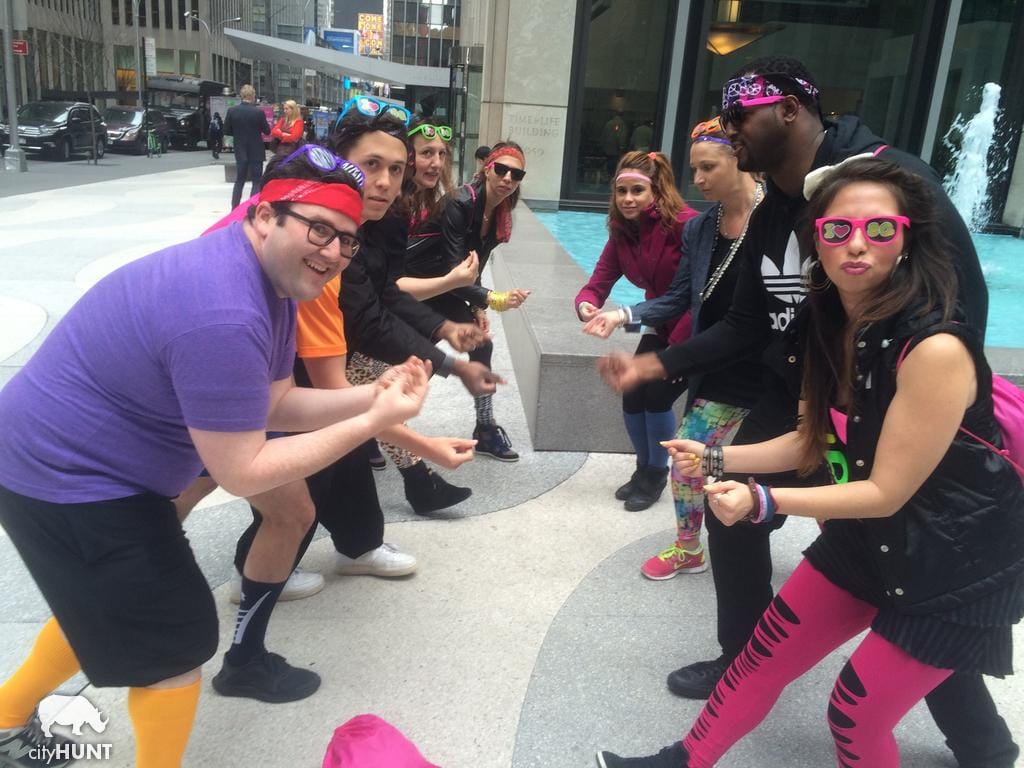
In a scavenger hunt, every team is playing the same game across the same space, and they can see in real time how they stack up against each other. It is not four to six people bowling in their own lane, it is your team against that team, out in the open, the whole time. We even write collaborative clues where you have to track down another team and do something together before you can move forward, so within the same hour you end up both competing with and cooperating with people from outside your own group.
That is very hard to pull off with a fixed activity in a fixed room, but it becomes easy once the whole city is the board. It is also how you scale. Three thousand people signed up for one we ran with Google, and because the city itself was the game, we could spread it over a few days and let small teams play whenever it suited them, all inside the same experience.
Team Building Activities for Large Groups That Include Everyone
This is the part almost nobody plans for. In any big group, some people are genuinely excited to be there and some people would rather be anywhere else, because they have a lot going on and this is the last thing they want to do. If you only build for the enthusiastic ones, you lose everyone else in the first ten minutes.
So we build for everybody, for introverts and extroverts, for the people who want to be there and the people who do not. If someone cannot move around, they can join as a virtual team member over Zoom and solve clues that only they can unlock, and if someone is quiet and would rather not be on camera, we hand them the problem-solving role, where the thinking itself is the contribution. Different mobilities, different personalities, all of it accounted for before the game ever starts.
The other thing we design around is alcohol, or the lack of it. A lot of team building is still built on a bar, and the moment you are not drinking, you feel left out. We actually started as a scavenger hunt pub tour company, so I know this one better than most. For years I did not have enough faith in the game to believe it would land without alcohol, and then clients started asking for it dry, and it was still great. That was an awakening for me. These days most companies are drinking less and looking for a safe way to get everyone interacting, and that is exactly what this became.
Surprise and Delight Is What Makes a Large Group Event Feel Personal
The last thing that makes a large group feel connected is that the game feels like it was built for them. Because it was.
Before every event, our producer interviews the group to find out what their goals are, what they are into, and what the inside jokes are, and then we build those details straight into the clues. My favorite version of this is what is called surprise and delight, a moment in the game that lands on something personal nobody ever told us we could know. If it is someone's birthday, we will write a clue that sends every team hunting for that person to sing to them, and often the birthday person has no idea we knew. They solve a clue, something unlocks, and the whole room is left wondering how we could have possibly known that.
Surprise and delight is a real, studied idea, and it works in any team building event where the surprises land during the game rather than after it. For a large group it does something specific: it takes an event that could easily feel generic at scale and makes it personal for two hundred people at once.
Large Group Team Building Is a Design Problem
I have run large events almost every way there is, from escape rooms and Topgolf and axe throwing to scavenger hunts across whole cities. One Halloween, back when Groupon was launching, we ran an event out of a rented club in the meatpacking district in New York, on October 31st, in the middle of a snowstorm. It snowed and sleeted the whole night, and we still got a full crowd in costume to the final location by folding the weather into the game in real time as it came down.
That is what you learn after enough big rooms. Keeping a large group connected comes down to design. The team size, the one shared game, the real competition, the clues that make people cross the room, and the care taken for the person who did not want to come at all. Get that right, and the size stops being the problem.
If you have a large group and you want them to actually leave connected, come find us at cityHUNT. We will make the whole city the game.