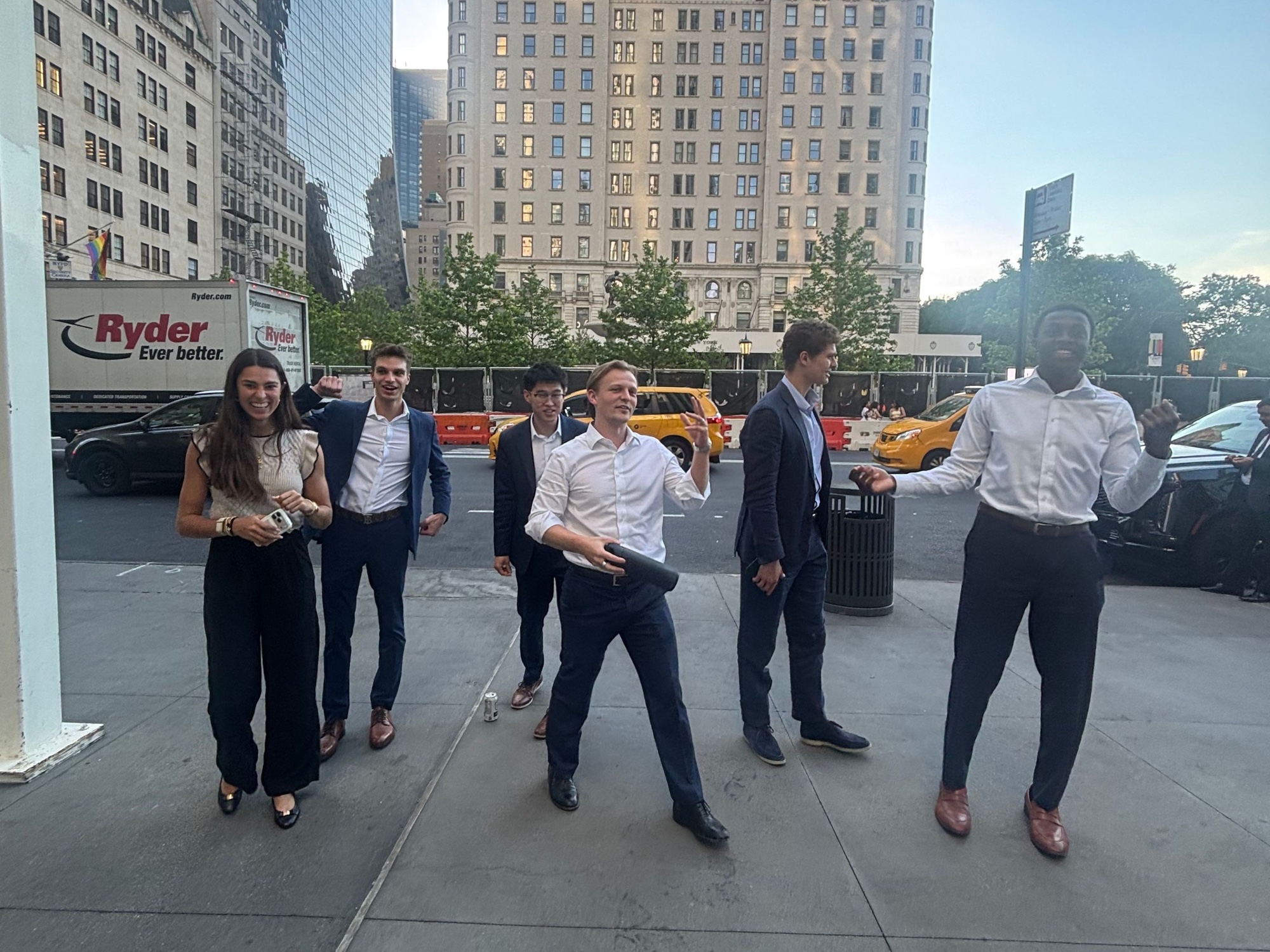
Outdoor Team Building Activities, and What to Do When the Weather Turns
Outdoor team building activities beat indoor ones almost every time. Here's how to build one so a bad forecast only changes the route instead of the whole day.
Every planner asks me the same question about outdoor team building, and it's never really about the activity. It's about the sky. What happens if it rains, what happens if it's too hot to walk anywhere, and what happens if the whole company is standing outside watching them get it wrong.
After more than 25 years of running these, my answer hasn't changed. It's better to be outside than inside. People enjoy it more, and you should default to outside. Then you build the event so the weather can't take it away from you. You use an activity that doesn't need equipment, because people can play on the phones they're already carrying, and you build the indoor stops in from the start instead of bolting them on afterwards as the backup. Do that and rain is something you work around instead of something that ends the day.
Outdoor Team Building Activities That Don't Feel Corny
It's better to be outside than inside. I say it to every client, because most of them have already been talked out of it. People enjoy it more, they're getting fresh air and oxygen, and at the end of the day the science backs that up. Being outside makes people happier, and happier people are better at work.
Nature doesn't have to mean a forest. Urban nature is enough, honestly. A street nobody's ever walked down, a market, a park that was three blocks from the office the whole time. That all counts. We coined the phrase urban safari more than 25 years ago, and it still holds true.
A conference room in an airport hotel is not that. You spent all this money to get everybody there, so show it off.
Corny is the real fear buried in that search, I think, and it usually comes from being made to perform in front of your colleagues. So what we do instead is give people something to solve. They're out in a neighborhood, they're moving, they're working through a list of things to find, and the connection comes out of doing that together. Nobody has to volunteer anything about themselves to a circle of coworkers.
Outdoor Team Building With No Equipment
A lot of people search for outdoor team building activities with no equipment, and I get why. Nobody wants to be the person hauling a truck of cones and ropes into a hotel parking lot.
You don't need any of it. We don't need equipment, because people use their phones to play the game.
It took us a long time to get there. We started with Polaroid cameras. Then we had digital cameras. Then we had iPods and now people would rather use their own phone than anything we hand them, so a cityHUNT has become a zero equipment team builder, which is great. If somebody can't get to the app store for whatever reason, they can just play the whole thing on a mobile platform instead. Nobody has to sit out because of their phone.
That helps you outdoors more than it helps you anywhere else, because the less gear you're depending on, the less the weather can take away from you. A phone in a coat pocket is about as weatherproof as equipment gets.
The Philadelphia Event Where Nobody Wanted to Get Wet
I don't usually get to guide events anymore, but this summer has been amazing. I've been traveling around and my kids have been interning with me. One of those events was in Philadelphia. Smaller group, and I was guiding it myself.
The weather wasn't good that morning but it was going to clear up, and we knew that going in, so we'd built the game with it in mind. We always tell clients the same two things beforehand: weather appropriate clothing and comfortable shoes. Some of the people did not listen. They came downstairs, saw the sky, and started pushing back. This client was pretty awesome about it, though. They'd gotten ponchos for everybody.
The other thing Philadelphia has is Reading Terminal Market, which is a huge indoor space, an old rail terminal packed with restaurants and vendors, a lot of square footage under one roof. So some of the teams were concerned, they didn't want to get wet at all, and I told them they could just go over to Reading Terminal and do most of their clues in there. A couple of teams opted for it.
But then a lot of people, once they start playing, they realize they're not going to melt. It wasn't even really raining and then it's fine, and honestly it's more fun than it would have been inside.
Indoor Team Building Activities Work Better as a Hybrid Than a Backup
But we don't treat indoors as the sad fallback you switch to once the day is ruined. We build indoor stops into the game itself. In most cities we run, there's an indoor option sitting in the route before anybody has looked at the forecast, because we're in urban environments and there are so many indoor places to go.
So if the weather turns, nobody has to make a decision in the moment, because the indoor option is already sitting inside the game. Even if it doesn't turn, people can still take a break from the rain or the heat or the cold and keep doing clues where it's comfortable.
If a client gives us enough notice we can go further than that and move a whole game indoors. Most major cities have somewhere that works, a Grand Central, a museum, a covered market. We've run events that were completely indoors and they were good events.
The tricky one is the activity that only exists outside. If you've booked people to build sandcastles, there's no indoor version of that. When it rains there's nothing to fall back on, so you end up improvising a different event in front of everybody, and they can tell. That's the thing to check before you sign anything: does this activity still exist if the weather is bad?
Outdoor Team Building for Large Groups
A big group outdoors sounds harder than a big group indoors. In my experience it's actually easier, because the city is the venue. There aren't many private rooms that comfortably hold a few hundred people, and there's no shortage in the city.
The other thing planners worry about with a large group outdoors is losing everybody. You picture two hundred people scattering across downtown and never being in the same place again. That isn't how it works. Everyone plays the same game at the same time, in small teams, spread across the same few blocks, which keeps everyone together and keeps everyone participating at once. Outdoors just gives you more room to spread them out and more for them to find. It's the same mechanics I've written about in keeping large groups connected during team building. You still need the weather plan built into it from the start.
The Rules I Give Every Client Before an Outdoor Event
Weather appropriate clothing, comfortable shoes, have a backup plan. That's the whole list, and I'd tell people the clothing part more than once, because some of them will not listen and you want the ponchos ready for when they don't.
Default to outside, because people enjoy it more and the science is on your side and have an indoor option for if outside becomes impossible, or a way to make it work anyway. The important part is that the indoor option lives inside the event rather than next to it, so if you need it you aren't canceling anything, you're just changing the route.
Do that and the weather stops being the thing you carry around all week and sometimes it's going to rain anyway, which is fine, because once people start playing they realize they're not going to melt.
If you're planning something outdoors and you want it to survive whatever the forecast does, come talk to us at cityHUNT. We've been running them in the rain for a long time.